
New York Arrests and Booking
New York runs booking through many separate doors. No single live roster spans the state. County jails, municipal police lockups, State Police arrests, New York City bookings, juvenile matters, and federal cases each sit in their own records. People already released sit in their own records too. The 62 locality files describe very different setups. Some sheriffs run a current custody search. Others post selected arrest news or a weekly report. Many have no public same-day roster of names and booking photos. One result from one place never covers the whole state.
A current jail list answers a narrow question. It shows who appears in that facility's custody at the moment of the search. It does not show where the arrest happened. Someone may get an appearance ticket, go free after processing, or wait in a city lockup. The list can therefore omit people arrested in that very county. County custody pages also set their own update and photo policies.
The New York State Police Media Reports grid organizes current troop and zone activity by day. The agency does not archive those daily reports. Older events call for preserved newsroom releases or a records request. The NYSP activity grid image shows that troop-and-zone report layout rather than a statewide booking database. The statewide window pages below separate a same-day check from the broader multi-day log. Neither promises a complete list.
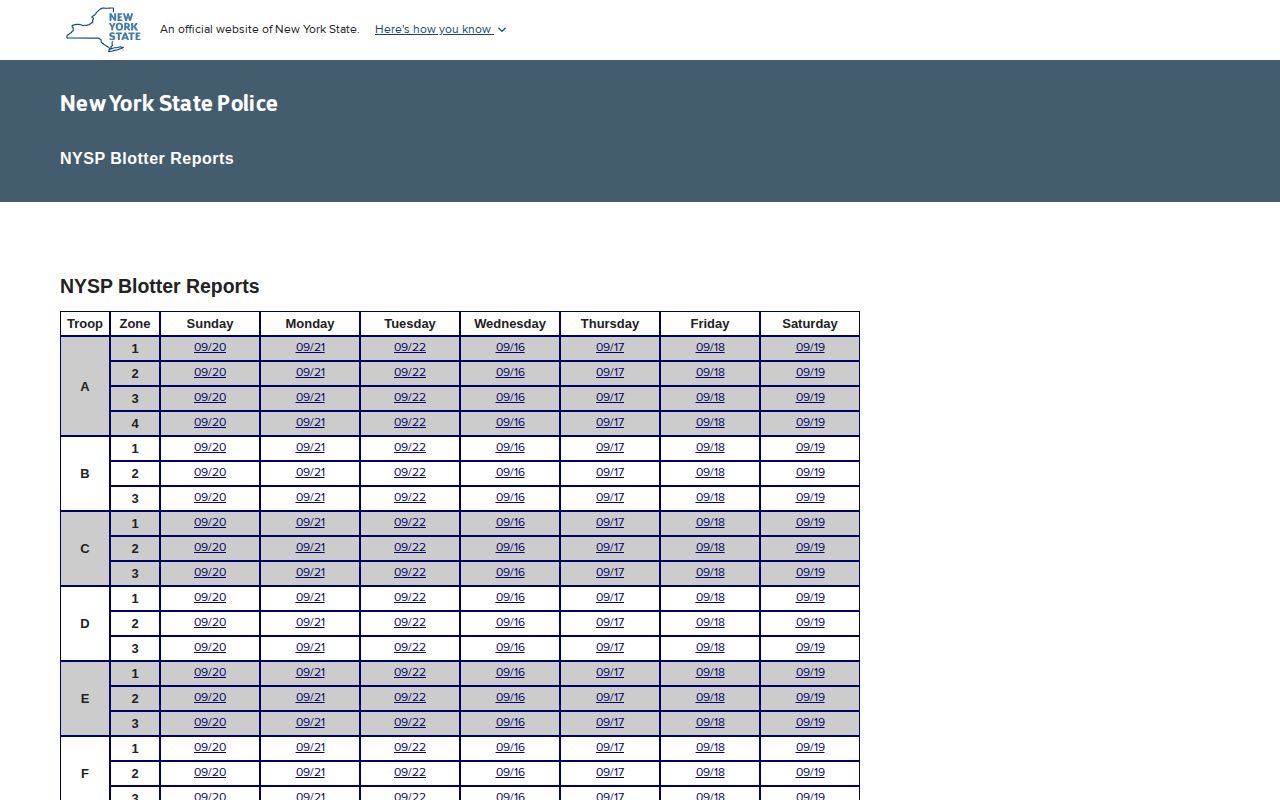
It stays an activity view, not a booking database. Older items take a records request or saved newsroom releases.
New York County Routing
Location comes first. Start with the place and agency named on an official release, ticket, or court paper. New York State Police can arrest someone in one town while a court sends that person to a county jail somewhere else. The county roster then shows that jail's custody only. It misses arrests that never reached the jail. New York City adds its own wrinkle. The five boroughs run a municipal correctional system, not a sheriff-style roster.
Once the county is clear, open the New York County Directory in the main navigation to reach that locality's site. City pages there explain local police coverage. The county source still matters most when someone was moved into county custody. If no agency is named, search broadly. Then confirm any match with the agency that made the arrest.
Publication styles differ widely. Wayne County's sheriff search groups custody entries by booking date and can show an in/out status, while Allegany County's official inmate search can include images in some records. Yates County's search may show a missing-image field. Washington County posts selected "Recent Arrests" material instead of a full rolling roster. These are examples of the range, not the full statewide list. Search controls vary too. Use each source's own fields and sort choices, then read the status or event date it gives.
| System | Documented search or roster fields | Scope |
|---|---|---|
| Wayne County Sheriff inmate search | Records are grouped by booking date; entries may show IN/OUT status and a photo. | Current county custody view, with no fixed refresh or retention promise located. |
| New York VINELink route | Search by a person’s name or an agency identifier when known. | Custody check and alerts; it is not a photo roster or guaranteed fresh-arrest list. |
| DOCCS inmate lookup | DIN, NYSID, or name and birth year. | State custody or supervision, not local booking. |
- Use the arresting agency or court record to identify the likely county or city facility.
- Open the official roster for that facility and use only the name, date, or identifier fields it offers.
- Read booking-date, status, and update labels carefully; a current custody result is not the full arrest history.
- If the entry is absent or a fresh booking is at issue, contact the agency records unit and request the event record.
Arrested in New York Today
“Last 24 hours” is not a statewide promise. Some county views are current custody lists without a fixed refresh time; others are selective news summaries or activity reports. The NYC Department of Correction says its release-information data may lag arrest by 48 hours or more and excludes people kept only in police lockups, juveniles, federal or state custody, desk appearance tickets, bail, and release on recognizance. That makes the city system a poor first check for a brand-new arrest.
For a fresh event, check the arresting agency’s release and then the jail or city facility named in the court or agency record. If the person is not found, contact the likely records unit and make a focused request. A custody alert service can help track one known person after data reaches its feed, but does not replace an immediate agency check. A missing entry is not proof that no arrest occurred.
Booking and custody systems update on their own schedules. A recent event deserves a second check. Confirm with the arresting agency or the named jail.
Where New York Arrests Appear
The right source depends on the stage. Start with official agency material. It names its custodian and its scope. Secondary state sections and news searches can help locate a report, but they may omit counties, keep stale copies, or use a different meaning of "arrest," and they never confirm present custody.
| Source | Best use | Limit |
|---|---|---|
| County sheriff or jail roster | Current custody at the named facility; some pages include booking dates, status, or photos. | Not all arrests; image and update policies vary. |
| Same-day arrest view | Daily Arrest Report: routes to the state's documented county and city sources for the shortest window. | There is no statewide 24-hour roster; posting lag and coverage differ. |
| Multi-day blotter | Weekly Arrest Log: compares county reports, State Police activity, news blotters, and archive depth. | Windows differ; the NYSP daily grid is not archived. |
| State Police newsroom and media grid | Official NYSP arrest releases, troop activity, and enforcement campaigns. | Selective releases; the daily grid is not archived. |
| County activity logs and arrest reports | Local daily or recurring summaries, including official county examples. | Some list activity or jail census only, not named bookings. |
| eCourts and court clerk records | Later case events and dispositions when the matter is public and entered. | Not a live jail list; sealed and restricted cases may be absent. |
| RecentlyBooked, BustedNewspaper, Mugshots.com, Arrests.org, and Mugshots.zone | Secondary leads or publisher policy information. | Unofficial, uneven in county coverage, and not a current custody check. |
The statewide arrest-log page extends this source map for county reports, NYSP activity, regional news, and archive limits. News outlets such as the Times Union, Syracuse.com, The Buffalo News, Newsday, and Spectrum News NY cover different regions. Their stories are reporting, not official booking records or court findings.
The official Washington County Recent Arrests page illustrates a selective sheriff publication rather than a complete live roster.
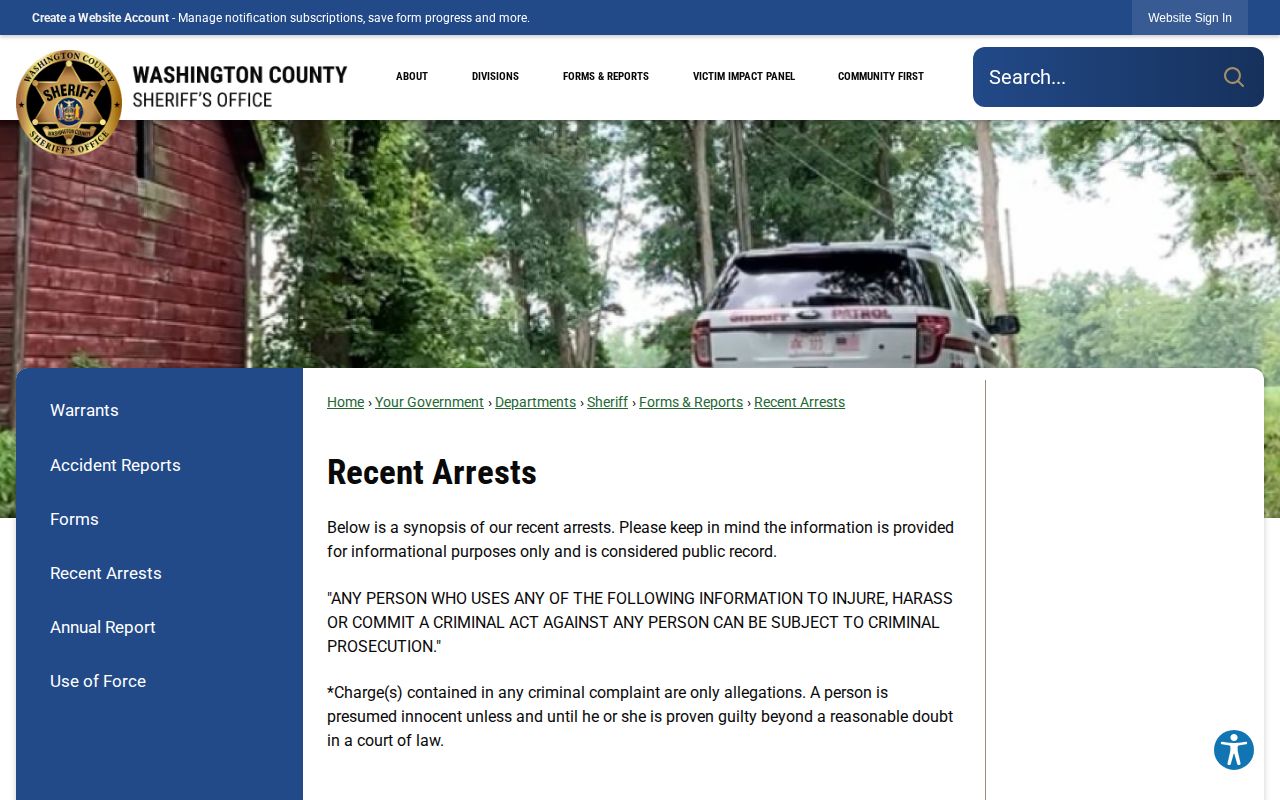
The sheriff sets its scope, not a statewide index.
The New York Booking Record
A New York booking record starts at jail intake. The public version can be far thinner than the agency file. Correction Law §500-f requires every local jail to keep a permanent master summary or daily record of commitments and discharges. That ledger holds a lot. It tracks entry date, name, offense, sentence, fine, age, sex, birthplace, race or color, education, occupation, committing authority, discharge, and prior convictions. This statutory record is not an online roster. Nor does it make every field fair game for republication.
Roster fields vary by agency. What one county publishes, another keeps off the web. Wayne County, for instance, groups its jail list by booking date and flags in/out status. No single field set applies across New York. State law also gives agencies a photo-specific privacy ground. So a booking photograph may stay hidden even when the custody result itself is public.
| Record layer | Fields or details the source establishes |
|---|---|
| County jail commitment record | Entry date, name, offense, sentence, fine, age, sex, birthplace, race or color, education, occupation, committing authority, discharge, and prior convictions under §500-f. |
| County online roster | Published custody result; Wayne groups by booking date and may show IN/OUT status. Other county views may display a photo, omit it, or publish no public roster. |
| NYSP incident or investigation file | Request the specific incident or investigation record from the NYSP Central Record Bureau; the source does not promise a uniform statewide public field list. |
| DOCCS public profile | Search by DIN, NYSID, name, and birth year; a result may show state facility, status, or certain release/former-inmate details. It is not a booking-photo promise. |
Keep the layers separate. A county jail record covers local commitment and discharge, a State Police incident file stays with NYSP, and a DOCCS profile begins only after sentencing or a transfer into state prison or community supervision. Each answers a different question.
New York Booking Photos
New York counties handle booking photos differently. Some custody searches display images, while others hide the field or show a missing-image marker. Some agencies post selective arrest-news pages, and many counties offer no complete public photo roster at all. A missing image does not mean no photograph exists. A third-party copy does not mean the agency would release it under FOIL.
For someone in state custody, the official DOCCS inmate lookup offers one route. It searches by DIN, NYSID, name, and birth year. That is a custody profile, not a fresh booking search. It promises no booking photograph. DOCCS records requests go through its own FOIL route. Federal BOP custody is a separate system. That system has no public photo gallery.
The Mugshots.com New York section is a secondary publisher page. It is not a state roster.
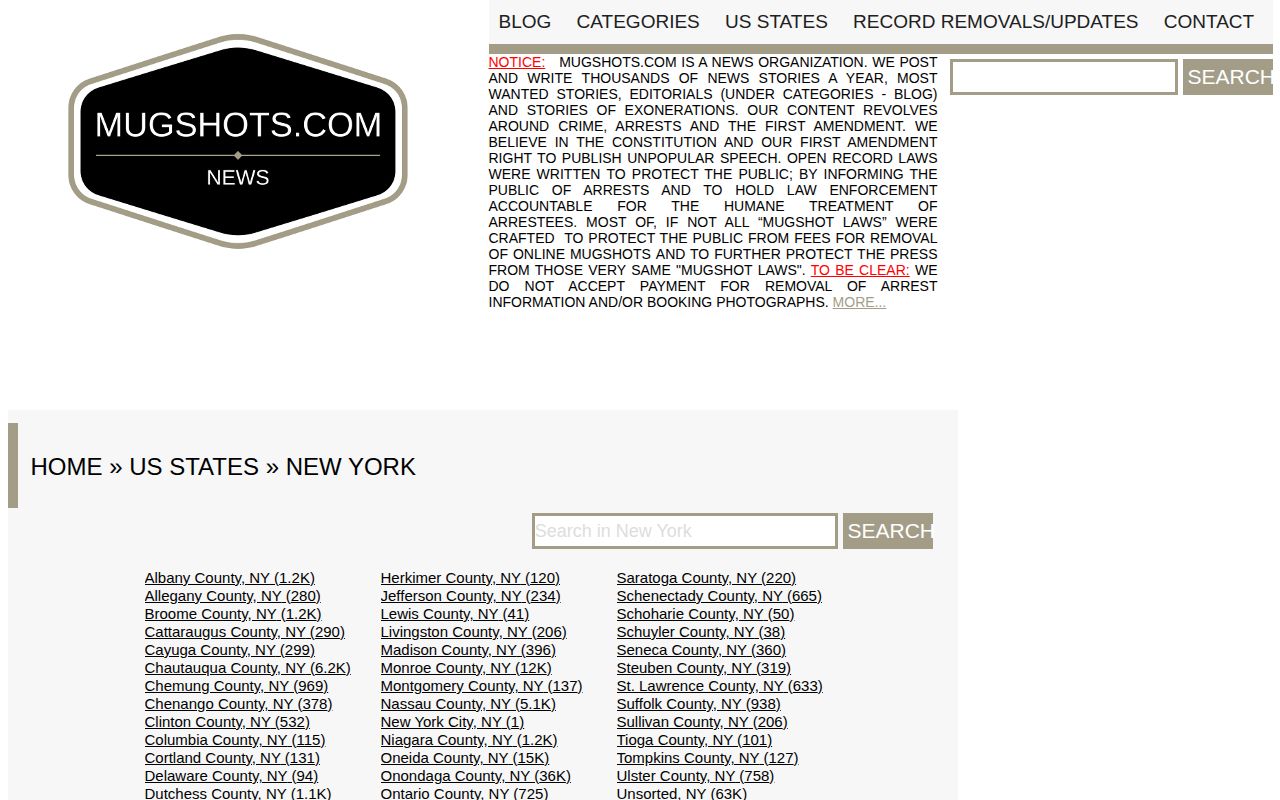
Private listings can carry stale details. Confirm the arrest with the originating agency and the court before relying on a copy.
New York Arrest Record Requests
A narrow, specific request gets a faster FOIL decision. Ask the office that holds the record. County sheriff or jail for local bookings. Police department for its incident file, NYSP for a State Police record, DOCCS for a state-corrections file. New York's FOIL guidance explains access to existing agency records. But FOIL cannot force an agency to build a new statewide arrest list it never kept.
- Identify the record holder. Use the arresting agency and the named jail or court. If the event involved NYSP, use its Central Record Bureau; if it involved a local sheriff, send the request to that county’s records unit.
- Describe the event. Include the arrest date or range, name if known, location, agency or troop, type of record, and preferred format. Ask for releasable portions if a report contains protected details.
- Use the agency’s request path. State agencies must offer online submission; email may be used where the agency has a reasonable method. NYSP links to its GovQA request form and accepts mail through the Central Record Bureau.
- Track the response. Under FOIL, an agency ordinarily makes a record available, denies access, or acknowledges the request with an approximate decision date within five business days. If it cannot act within twenty business days, further written explanation and a date certain are required under the statute.
- Review cost and appeal rights. The usual state paper-copy fee is up to 25 cents per page for pages no larger than 9 by 14 inches, unless another cost rule applies. A denial may be appealed within thirty days; the appeals officer has ten business days to decide.
NYSP charges by item. An incident or investigation report costs $15. Accident reconstruction runs $15, a certified copy $15, and photographs $25, all beside the standard page fee; digital media costs $3. Its current request page says it tries to answer within five business days. That is a first response, not a finished production, since complex requests and redactions take longer. Check the current fee page before sending payment.
DOCCS keeps a separate FOIL page and connects to the Open FOIL portal for records beyond the public inmate profile. Its lookup covers state custody only, not county bookings. A booking-photo request faces privacy review, not automatic release.
New York Court and Custody
Once an arrest reaches court, the docket answers a different question than the roster does. New York's eCourts includes WebCriminal and other court-search tools where data is available. Recent entries can lag. Sealed, juvenile, and youthful-offender cases may never appear. For a formal outcome, ask the court for a Certificate of Disposition, which lists the charge, the result, any conviction date, and the sentence.
The statewide Criminal History Record Search is a different product. This paid court-history tool costs a stated $95 and covers all 62 counties, subject to its exclusions. It is not a same-day booking source. It is not a certified disposition either. A blank case search can mean a delayed or restricted entry. It does not prove the arrest never happened.
For state prison or community supervision, use the DOCCS lookup with DIN, NYSID, name, or birth year. The profile may show facility, status, and some release or former-inmate details, but it is not a booking-photo service. The BOP locator covers federal sentenced custody from 1982 forward and updates daily. Someone held pretrial may sit with the U.S. Marshals instead. ICE's detainee locator demands exact identifying details. Neither federal route replaces county arrest records.
Charges recorded at booking are only the start of a case. The court record shows how it ends.
Older New York Records
When a jail roster vanishes online, that says nothing about the paper trail behind it. New York agencies follow the local-government LGS-1 schedule. Item 1250 makes the master jail commitment and discharge summary permanent. Item 1251 covers a prisoner data file. That series is usually kept fifteen years after death or discharge. It becomes permanent once it replaces the master summary. Item 1252 prisoner case records stay on hand. The schedule decides when they are no longer needed. These are retention rules, not promises that a roster or photo stays public that long. The LGS-1 incarceration schedule adds shorter spans for other series. Daily population counts and visitation records last three years. Inspection records last six. Item 1224 governs local identification files. These hold arrest and disposition records, fingerprints, and photographs in hard copy or digital form. Sealing law applies alongside the schedule for every agency. A permanent commitment record still does not force a permanent public photo gallery. State Archives holdings for old prisons are spotty. Some case files survive only as a two percent sample for certain release periods. For state-prison material, the Archives' guide and search portal work best with certain details. Bring a full name, facility, admission or conviction date, and DIN when known. Name indexes are missing from some collections. Access can be restricted. No single fee or turnaround applies. The New York State Archives prison guide spells out these limits.
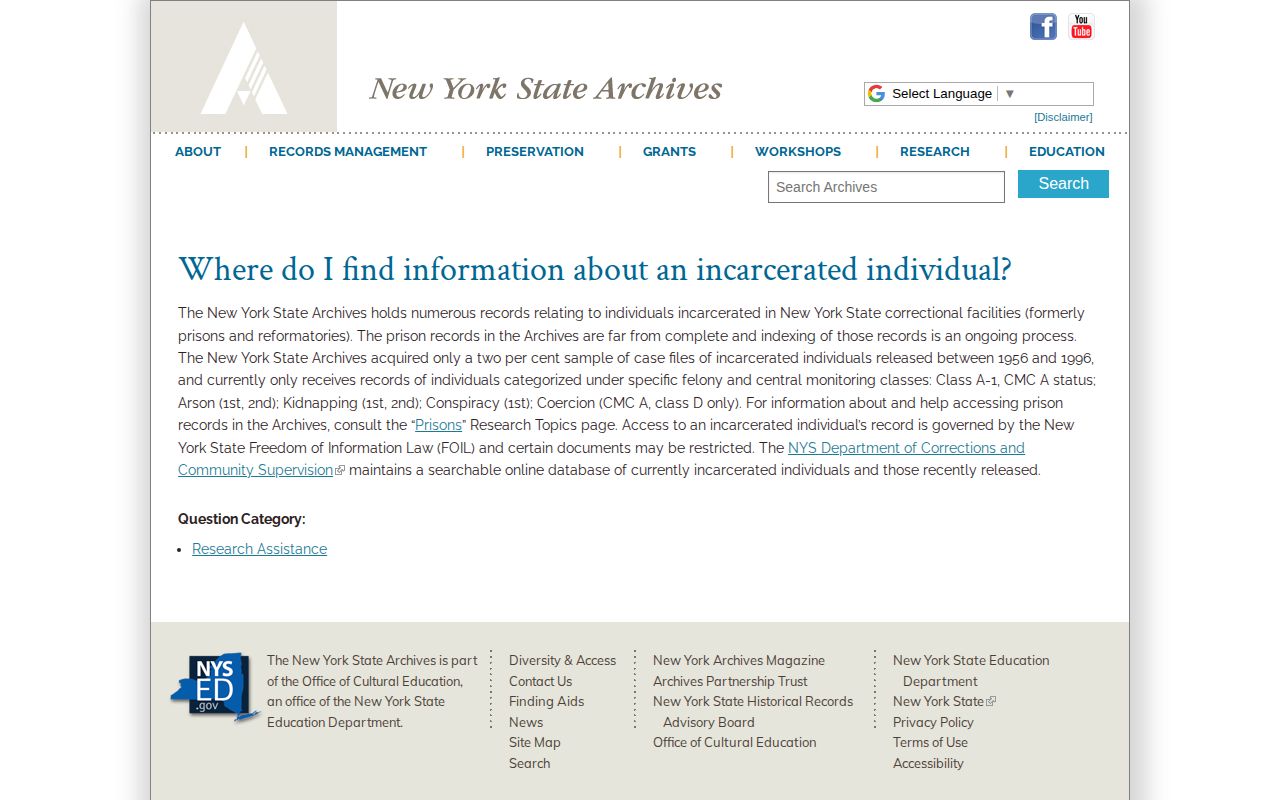
Older custody entries often slip past current search tools. The Archives collection is no statewide index. A missing entry there says little about the arrest itself, since local agencies keep their own files. For what those agencies retain, the retention schedule sits on the State Archives LGS-1 page.
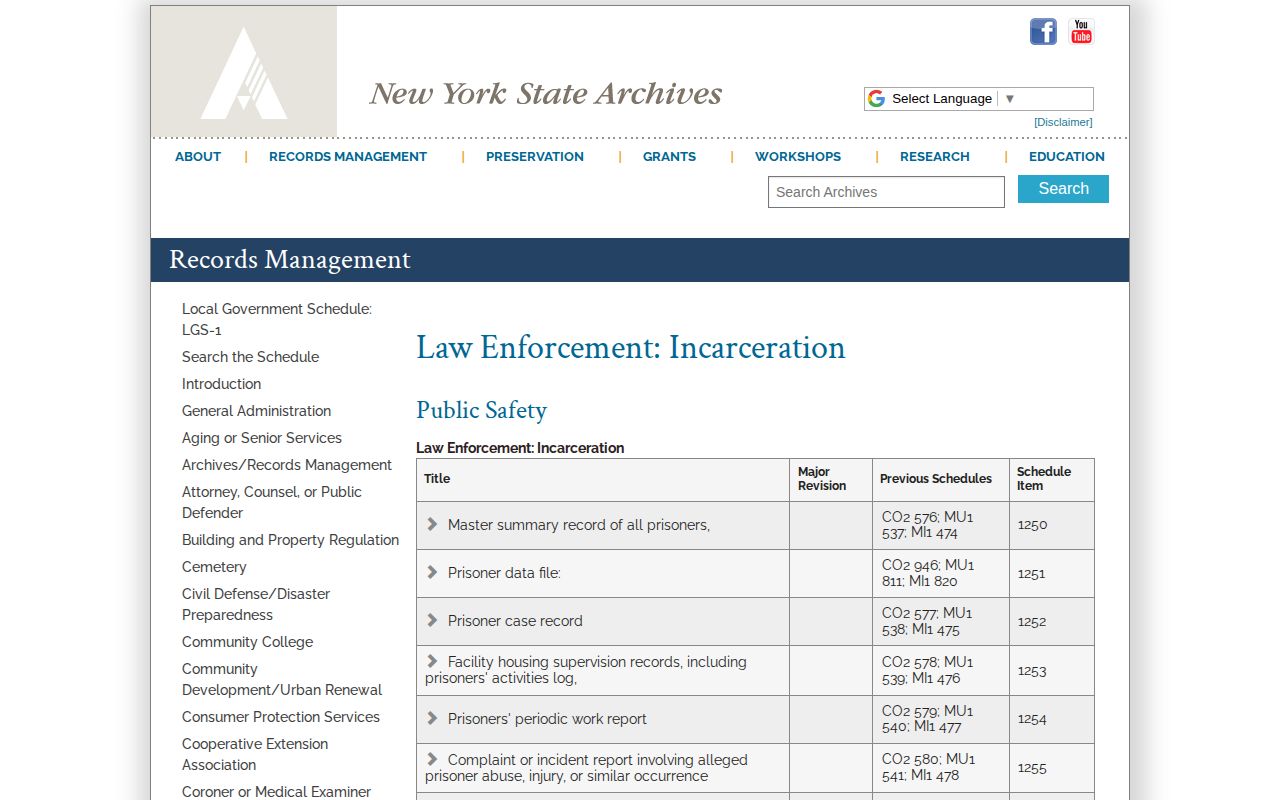
Those item numbers describe local agency holdings, not arrests.
New York Mugshot Law
New York's booking-photo rule is a privacy exemption, not a flat publication ban. Public Officers Law §89(2)(b)(viii) treats releasing a law-enforcement arrest or booking photograph as an unwarranted invasion of personal privacy. That applies unless the release serves a specific law-enforcement purpose and no other law blocks it. §87 still requires the agency to weigh the record and any other exemption. That is why photo practices vary by county. It is also why a FOIL request does not guarantee an image. The rule arrived in 2019. It came as Part GGG of the budget law, Chapter 59 of the Laws of 2019. Lawmakers pointed to photos that stayed online after cases were sealed, expunged, pardoned, or ended without conviction. Public-safety releases for law-enforcement purposes were preserved. Earlier and later bills, including 2015 S4537, 2019 S1998, and 2025 S7076, carry no force unless enacted. New York has no statewide rule compelling every private publisher to erase every copy. When a case is sealed or ends favorably, ask the agency for correction. Use the publisher's own free policy where one exists. No publisher is obliged to pull a page automatically. CPL §160.50 generally seals a case that ends in the accused's favor. It sets rules for notice and for handling photographs and identification records. The New York Courts sealed-records page describes the state's remedy as sealing rather than broad expungement. Certain marijuana matters may be expunged instead. Clean Slate automatic sealing began in 2024. Courts have until November 2027 to finish implementation. Eligibility, exclusions, and timing all depend on the case. Sealing the official record still leaves private copies in place. One publisher describes its own free update path. Mugshots.com's record-maintenance policy says qualifying requests cost nothing and may need a record identifier plus court papers. It separates an update from a removal. Processing can take up to ten business days.
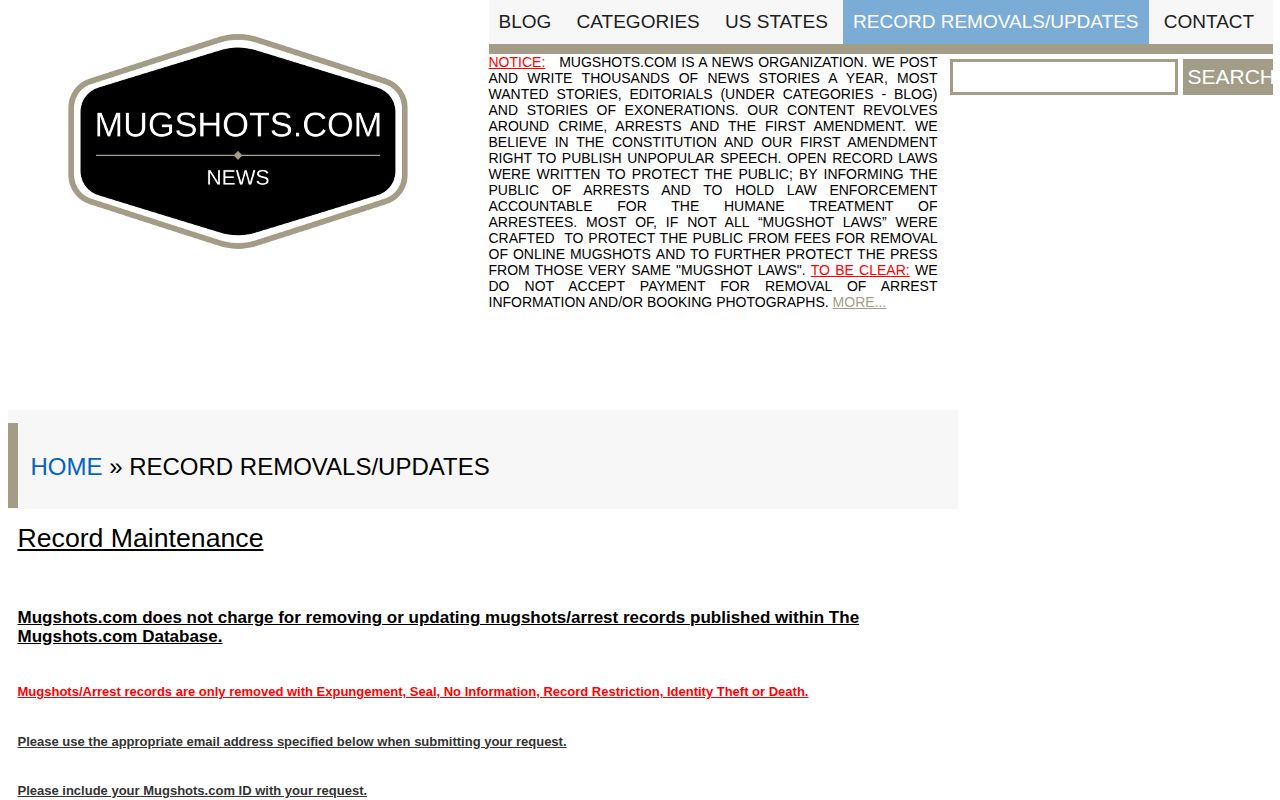
That policy stands apart from New York law. It may ask for court documents or a record number. RecentlyBooked's published policy lays out a free request process. Its form seeks the listing URL, name, arrest date, state and county. It also asks for a reason and supporting papers where appropriate. The New York state route does not reach every county.
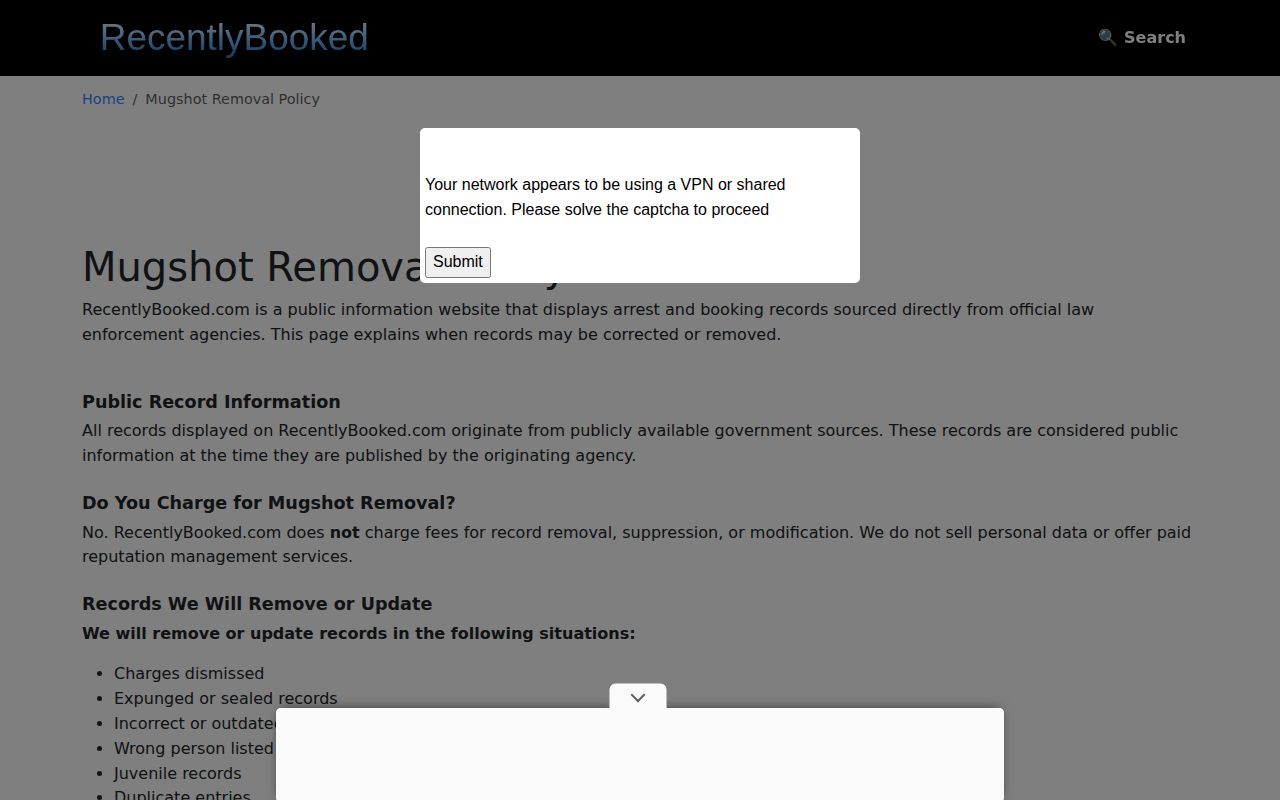
What you see there is a publisher policy page. It is not a court outcome or a promise of removal. BustedNewspaper's free listing form covers requests tied to error, sealing, dismissal, or another qualifying result. Proof may be required. The Arrests.org New York contact page posts no clear free removal process. Mugshots.zone runs on county subdomains. It has no confirmed statewide New York index. Its privacy policy offers a free request route for some errors or sealed matters.
Publisher policies are not New York law. Each one covers only the listing and proof its owner reviews. Skip any intermediary who guarantees a result; check the court status and go straight to the agency or publisher.
New York Arrests in Secondary Sources
Private arrest sites copy what county feeds publish. Their listings can be incomplete, stale, or drawn from an older feed. BustedNewspaper links out to county pages but skips many counties. RecentlyBooked advertises about thirty days of coverage. It posts multiple updates. Its New York state page still lists fewer than the 62 counties. Arrests.org also shows only selected counties. There is no statewide roster behind it. Mugshots.com runs a New York state route, yet it is not a complete official record. Mugshots.zone has no stable New York-wide landing page. Treat any secondary hit as a lead. A private site may keep a copied entry after the official source changes. Confirm custody with the jail or the arresting agency before relying on it. Court records hold the outcome. A state section on one of these sites can point you to a New York arrest listing. The site itself keeps no county records, though. Match its details against an agency or court record before you lean on them.
New York Arrest Warrants and Wanted Lists
Wanted lists in New York are split by agency and legal status. NYSP posts selected missing-person and wanted notices. DOCCS Most Wanted tracks fugitives and absconders from state correctional supervision. An entry may carry a DIN, conviction details, a last-known location, a physical description, and an investigator's contact information. Remember that a supervision warrant or absconder status is not the same as a new county booking.
Federal fugitives run through a different door. The U.S. Marshals Service handles the Northern, Western, Southern, and Eastern federal districts, with task-force information for New York City and Long Island. It posts no single public state fugitive roster. County sheriff warrant tools vary from place to place. Where no public warrant check exists, call the issuing agency or ask counsel how to confirm the court record. A generic county roster is not a warrant database.
Official wanted pages come with safety instructions. The DOCCS Most Wanted page warns that listed subjects may be armed and dangerous and tells you not to attempt an apprehension. For immediate danger it says to call 911, and it offers an official tip route otherwise. NYSP's Missing and Wanted page and the federal notices call for the same caution. Send information through the named channel. Never try to detain anyone yourself.
Wanted notices exist for safe reporting. Never approach or follow a listed person; use the agency's tip route, or call 911 if the danger is immediate.
Worried a warrant carries your name? Ask a lawyer, a court clerk, or the issuing office. Public wanted pages can omit sealed, local, or newly issued matters. A negative result is no legal clearance.
Custody After a New York Arrest
An arrest, a booking, custody, and the case outcome live in separate records. A roster drops a name once the jail releases or transfers the person. The booking record still exists. A State Police release may describe the arrest. It may not say where someone is later housed. The disposition sits in the court file.
| Stage | Best source | What it does not prove |
|---|---|---|
| Just arrested or processed | Arresting agency release, local record unit, or the named intake facility. | A release may be selective and posting can lag. |
| In county custody | County sheriff or jail roster; for NYC, the Department of Correction source if the person is housed there. | Current custody does not establish a conviction. |
| Released or moved | Records unit, booking record, court paper, or custody-alert system when participating. | Absence from a roster does not erase the booking record. |
| State prison or supervision | DOCCS inmate lookup using the available identifiers. | It is not a fresh arrest list or a photo gallery. |
| Federal or immigration custody | BOP, U.S. Marshals, or ICE locator as appropriate. | Each tool covers a different custody system; a missing result is not proof of no detention. |
Federal custody has its own lookup. The Bureau of Prisons locator searches people in federal custody, and it does so without any public booking-photo gallery. Names, register numbers, and facilities are what it returns.
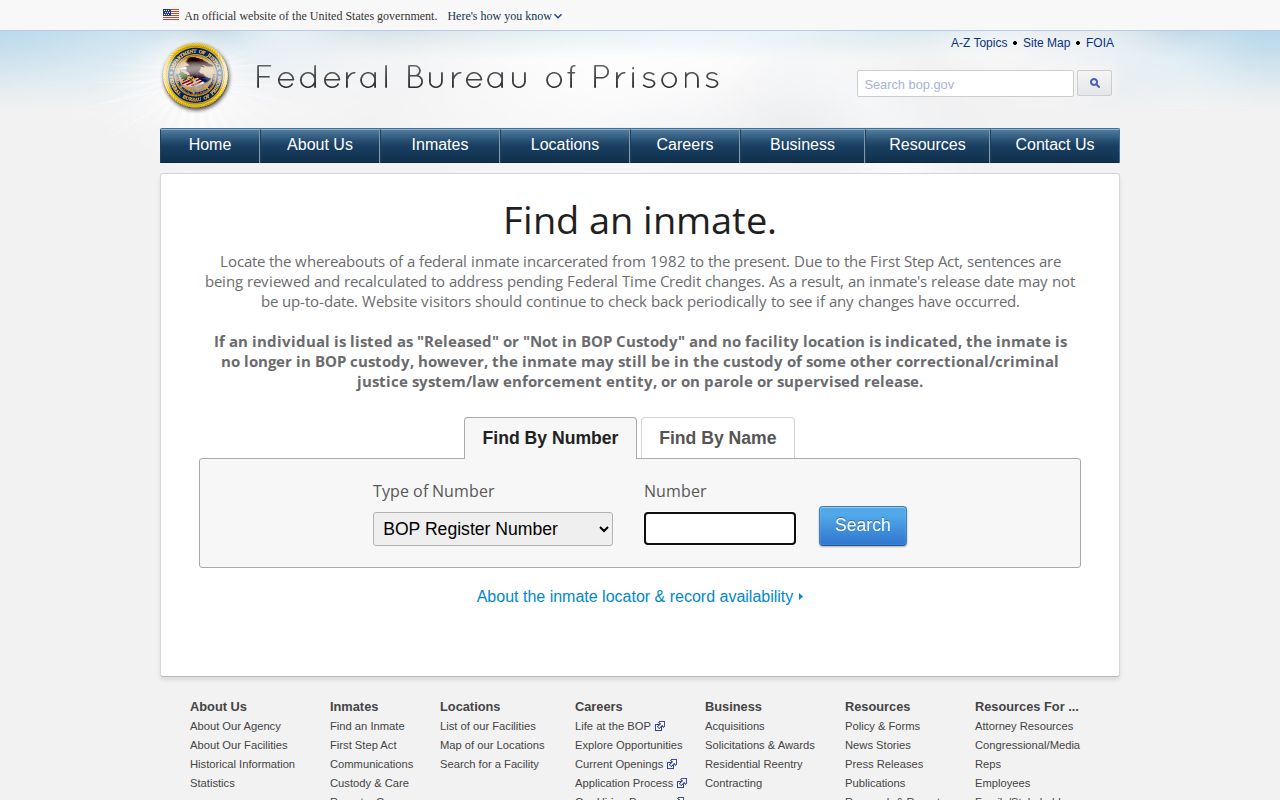
A Bureau of Prisons result reflects federal sentenced custody, while people held pretrial may sit with the U.S. Marshals Service instead.
New York Booking Terms
Each term below marks a different point in the process. Read one as another, and a stale or partial listing can look more final than it really is.
- Booking
- Intake and record creation after a person is delivered to a custodial agency.
- Arraignment
- A first court appearance where charges are addressed and the court sets the next procedural step.
- Disposition
- The court’s recorded outcome for a criminal case.
- Sealing
- A legal limit on ordinary public access to specified official records; it does not automatically delete private copies.
- Warrant
- A court order authorizing an arrest or another action stated in the order.
What does a booking show? It records the fact of an arrest and the facility where it happened. The rest of the case lives in the court file.