
Are New York Arrest Records Public?
Some portion of a New York arrest record is often open. The state simply does not treat every record the same way. Each agency fielding a request weighs it under the Freedom of Information Law. This is FOIL. It applies whatever privacy or law-enforcement exemption fits. A police report, a jail custody entry, a court file, and a booking photo are distinct records. Each follows distinct rules. A current jail roster names who that facility holds when its system updates. It is not a statewide arrest list. A court docket may trace later steps, but it is not the original booking record. Asking for one item does not unlock every related file.
The state's central photo rule hands agencies a firm privacy basis for withholding mugshots. Release is allowed only when it serves a specific law-enforcement purpose and no other law blocks it. Other pieces may still come out, sometimes with redactions. To find a New York arrest record, name the agency, date, and record type first. Then ask that office directly for what it keeps.
Note: A booking entry reflects an arrest, not a court outcome. Charges may change or be dropped.
New York Mugshot Privacy Law
The heart of the rule is Public Officers Law §89. Its subsection 2(b)(viii) calls the release of an arrest or booking photo an unwarranted invasion of personal privacy. That applies unless disclosure serves a specific law-enforcement purpose and no other law bars it. The companion §87(2)(b) carries the privacy ground. Other parts of §87 cover active investigations, fair-trial concerns, confidential sources, and investigative techniques. An agency has to tie any denial to a legal ground and to the record itself. That is not the same as a blanket ban on agency photos.
The 2019 budget law added Part GGG. Enacted through S1509-C, Chapter 59 answered sites that displayed photos indiscriminately. Those cases often ended without conviction or were later sealed, expunged, or pardoned. Lawmakers also acknowledged targeted release to identify a suspect, victim, or witness. Requests today follow the current statute, not pre-2019 commentary.
Introduced bills are not law. The record here lists 2015 S4537, 2019 S1998, and 2025 S7076. Each is a proposal on publication or removal. None creates a statewide deletion right. None replaces the FOIL privacy rule. New York has no statewide pay-to-remove statute on the books.
New York Records Still Available
A photo exemption is not the end of the trail. New York posts no single live roster covering every local agency, jail, State Police arrest, NYC booking, juvenile matter, federal event, or person released within hours. The right source turns on custody stage and record holder. The County Directory points to local options. The statewide arrest and photo landscape explains the variation.
Across the 62 locality files, some places run current searches, others post selective arrest pages or weekly summaries, and many offer no complete public photo roster at all. A jail feed reflects only its own custody list. A police release may cover just selected cases. A name that is missing can reflect timing, scope, or an exclusion. It does not prove the arrest never happened.
| Record source | What it can answer |
|---|---|
| County jail or local roster | Who a participating facility lists in custody; a fast release or delayed upload may be absent. |
| Agency records officer | Whether a responsive arrest, incident, or booking record can be released under FOIL, in whole or in part. |
| New York court search or clerk | Case events and disposition when a case is public and has been entered. |
| State custody search | Correctional custody information, not a fresh county booking or routine photo gallery. |
A state corrections search reaches people already in state custody. It will not surface a fresh county booking. It is also no routine mugshot source. Court systems can omit sealed cases, youthful-offender matters, cases not yet entered, and other unavailable files. An online search may not settle the question. Then ask the court clerk or the arresting agency.
New York FOIL Request Steps
FOIL covers records an agency already keeps. It does not force the creation of a new statewide roster. The Governor's Committee on Open Government guidance explains email requests where an agency offers a reasonable method. State agency sites must also provide an online option. Describe the item clearly, and skip requests for an entire file when one record will answer the question.
- Name the agency, county or State Police troop, arrest date or date range, and person or incident location if known.
- Describe the exact record, such as the arrest report, booking entry, or a releasable portion of an incident file. Ask for the format you can use.
- Ask the agency to identify any withheld portion and the legal ground. A photo request receives a separate privacy review under §89(2)(b)(viii).
- Track the response date. If denied, appeal through the agency’s designated appeals officer within the statutory period.
Send a FOIL request and the clock starts. The agency has five business days to respond. It can grant the record, deny access, or acknowledge the request with a target date for a full determination. Twenty business days is the hard ceiling. Past that point, the agency must explain the delay in writing and set a date certain. Denials can be appealed. You get thirty days to file, the appeals officer ten business days to decide, and the burden of justifying a denial stays with the agency.
Paper copies stay cheap. Pages up to 9 by 14 inches cost no more than 25 cents unless another statute sets a different rate. Search and production work, or other media, can cost more.
Note: A narrow request with dates and record types moves faster and keeps a photo request separate from a report request.
New York Privacy and Court Files
FOIL stops short of total disclosure. Family Court Act §784 keeps juvenile arrest information closed absent court authority. CPL §720.35 does the same for youthful-offender records. Civil Rights Law §50-b goes further and shields the identities of sex-offense victims. Active cases bring fair-trial, source, investigative-method, and public-safety concerns. Agencies can redact protected parts. That beats closing an entire report.
A court record differs from jail intake. A case may be sealed, involve a youthful offender, or simply not be entered yet. A favorable outcome later can seal the official record, but the earlier booking entry stays. Ask the clerk when a case will not appear.
The post-2019 Lockwood v. Nassau County Police Department decision applied privacy and FOIL exemptions to the records and facts presented instead of accepting a bare category label. No appellate ruling cited settles every use of the photo exemption, so a contested denial may still require an administrative appeal or legal advice.
New York Sealing Tracks
New York has several sealing paths. Each has its own trigger and exceptions, and none erases every copy held by courts, agencies, or private outfits. The rules sit in Criminal Procedure Law Article 160, while the court's Clean Slate information explains the newer automatic framework.
| Path | General effect and limit |
|---|---|
| CPL §160.50 | Favorable termination, such as an acquittal or dismissal, generally leads to automatic sealing, subject to statutory exceptions. |
| CPL §§160.55 and 160.58 | Separate rules cover many noncriminal convictions and specified controlled-substance matters; eligibility depends on the exact record. |
| CPL §§160.57 and Clean Slate | Automatic sealing applies to specified conviction categories. Implementation and statutory exclusions matter. |
| CPL §160.59 | A person may ask a court to seal up to two eligible convictions, no more than one felony, after the ten-year crime-free period and subject to exclusions, pending cases, notice, and judicial discretion. |
| Specified marijuana matters | Some records may be expunged under particular provisions; this is not a general expungement system for all arrests or convictions. |
Clean Slate took effect on November 16, 2024. The Unified Court System has until November 16, 2027 to implement automatic sealing, and the court page describes three-year and eight-year eligibility rules for many misdemeanors and felonies, with conditions and exclusions. It covers qualifying convictions only. It is not a fresh arrest search. Nor is it an instruction to private publishers. Implementation is ongoing, so check the court's current page before relying on any timing rule.
Sealing limits routine public access to court, police, and DCJS material. Section 160.50 reaches agency photos and identification materials too, subject to exceptions and return or destruction rules. Use the exact disposition, certificate, or order that fits. Sealed is not expunged.
Note: A certificate of disposition names the court result, but it does not prove every outside copy has been updated.
New York Arrest Record Retention
A record can outlive the roster. New York's LGS-1 schedule for local law enforcement and incarceration sets different retention periods for each jail series. Item 1250 is permanent. That item is the master summary of daily commitments and discharges kept under Correction Law §500-f. Item 1251 runs fifteen years after death or discharge. It becomes permanent once it replaces the master summary. Item 1252 is held until it is no longer needed under the schedule.
The schedule governs government record series, not a website's live roster. A permanent custody summary is not a permanent photo gallery. Daily population and visitation records carry three-year periods; inspection records run six years.
Photos follow separate rules. The Archives' identification-file schedule, item 1224 covers arrest and disposition records, fingerprints, and photo files, each with its own destruction point and sealing-law limits. The exact series and disposition matter before anyone can say how long an agency holds a photo.
Older research leads to the Archives too. Its New York State Archives prison-record guide warns that historical correctional holdings are incomplete, and some case files are only samples rather than a full index of everyone held. That collection serves older research. Current custody questions go through the state corrections search.
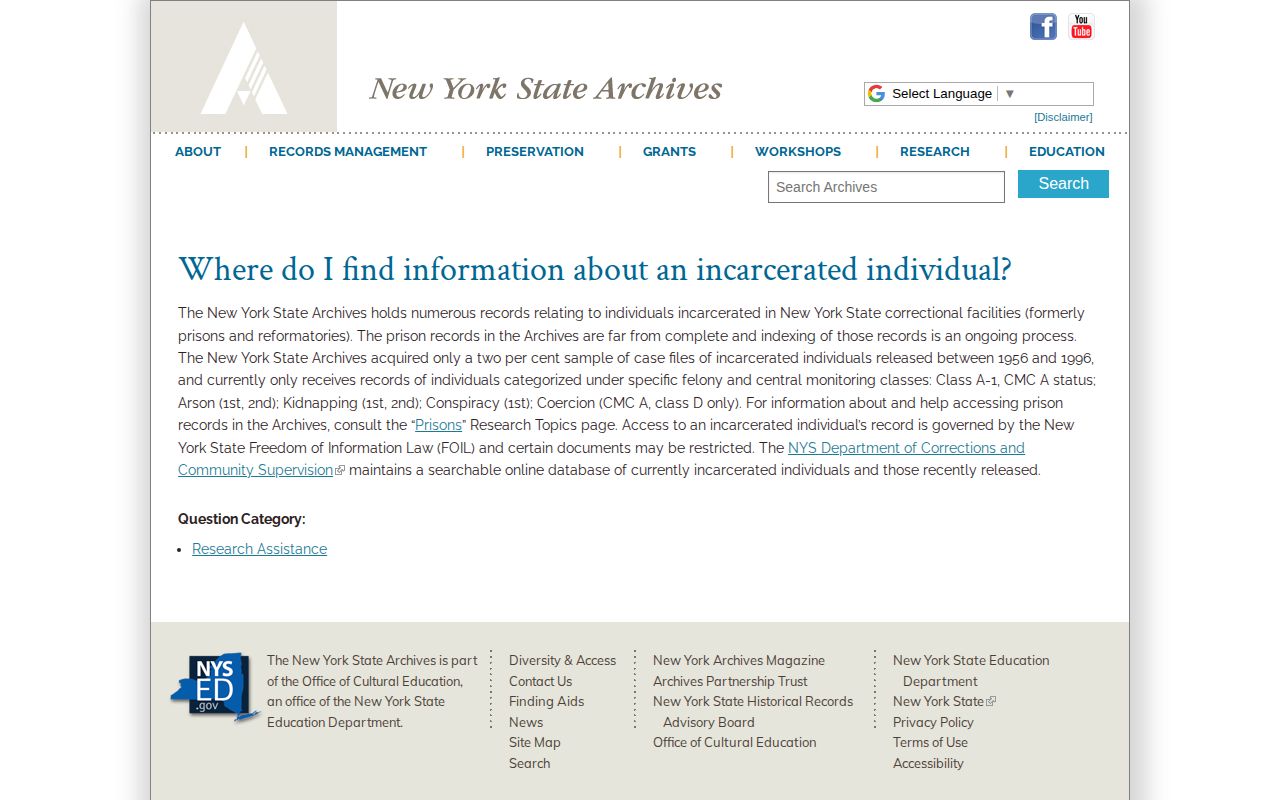
The Archives says so itself. A missing file does not prove no incarceration. When asking about a specific collection, give a name, facility, and date range. The LGS-1 schedule lists permanent and time-limited jail series in separate rows. That separation matters. It keeps a retention schedule from being read as a public roster.
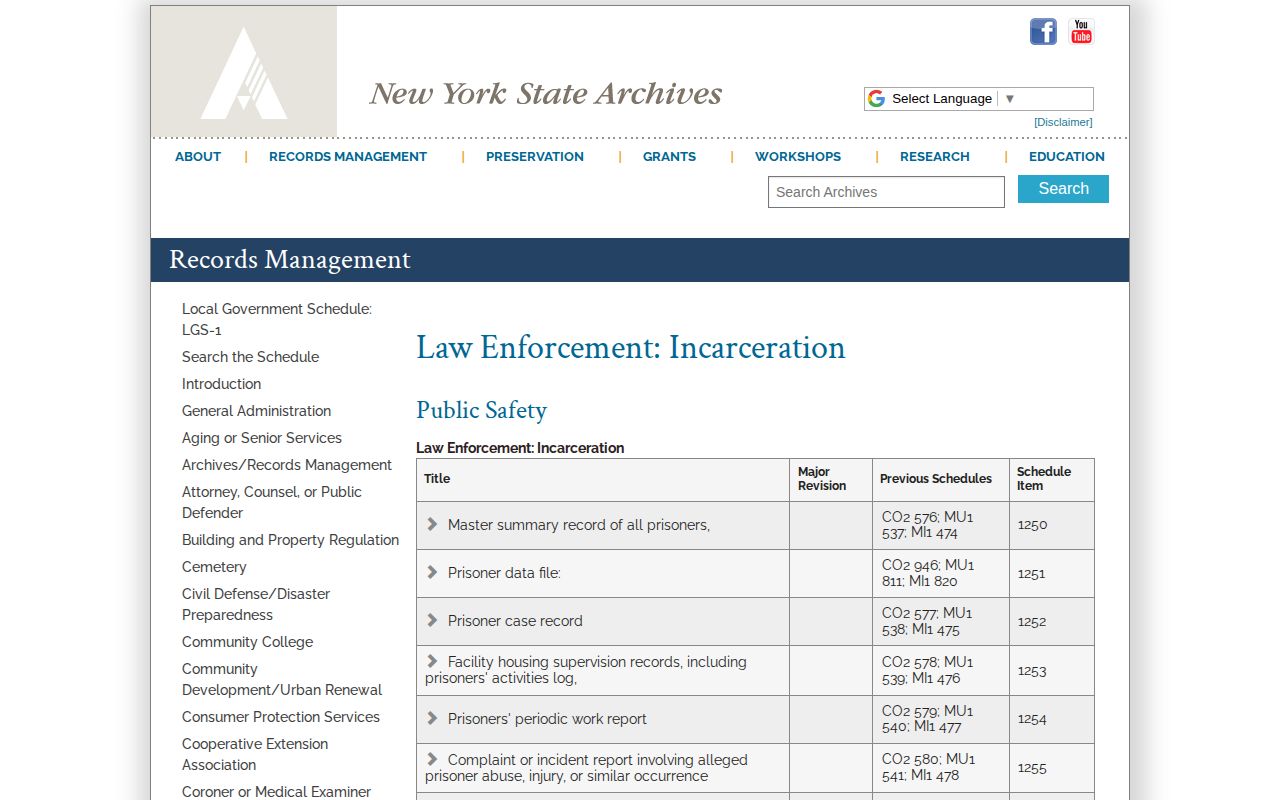
Item 1250's permanent status covers only the master summary. Data files and photographs follow their own schedule, plus any sealing requirement.
New York Free Publisher Requests
Sealing a record with an agency is one step. Getting a private publisher to drop a copy is quite another. An official copy may be locked down. An indexed listing can still live on. Free publisher requests each carry their own proof rules, and none of them promise removal.
BustedNewspaper’s free listing form wants the listing itself plus supporting proof. Qualifying reasons include errors, sealing, expungement, dismissal, or a not-guilty outcome. RecentlyBooked also runs a free request process. Its policy covers dismissals, seals, expungements, and errors. It also covers outdated or wrong-person listings, juvenile records, and duplicates.
The RecentlyBooked policy page lays out that publisher’s own review rules. It is not a New York legal decision. A strong request names the exact listing. It attaches the right proof.
This policy screen is a publisher’s request page. It is not an official New York record, and it promises nothing.
Mugshots.com’s record-maintenance policy treats qualifying requests as free. It also draws a line between removal and an update. Removal grounds include sealing, expungement, a no-information outcome, restriction, identity theft, or death. An update may rest on a dismissal, acquittal, not-guilty result, exoneration, pardon, or nolle prosequi. Documents must back the claim. The site asks for its record ID and legible court papers. Review runs up to ten business days.
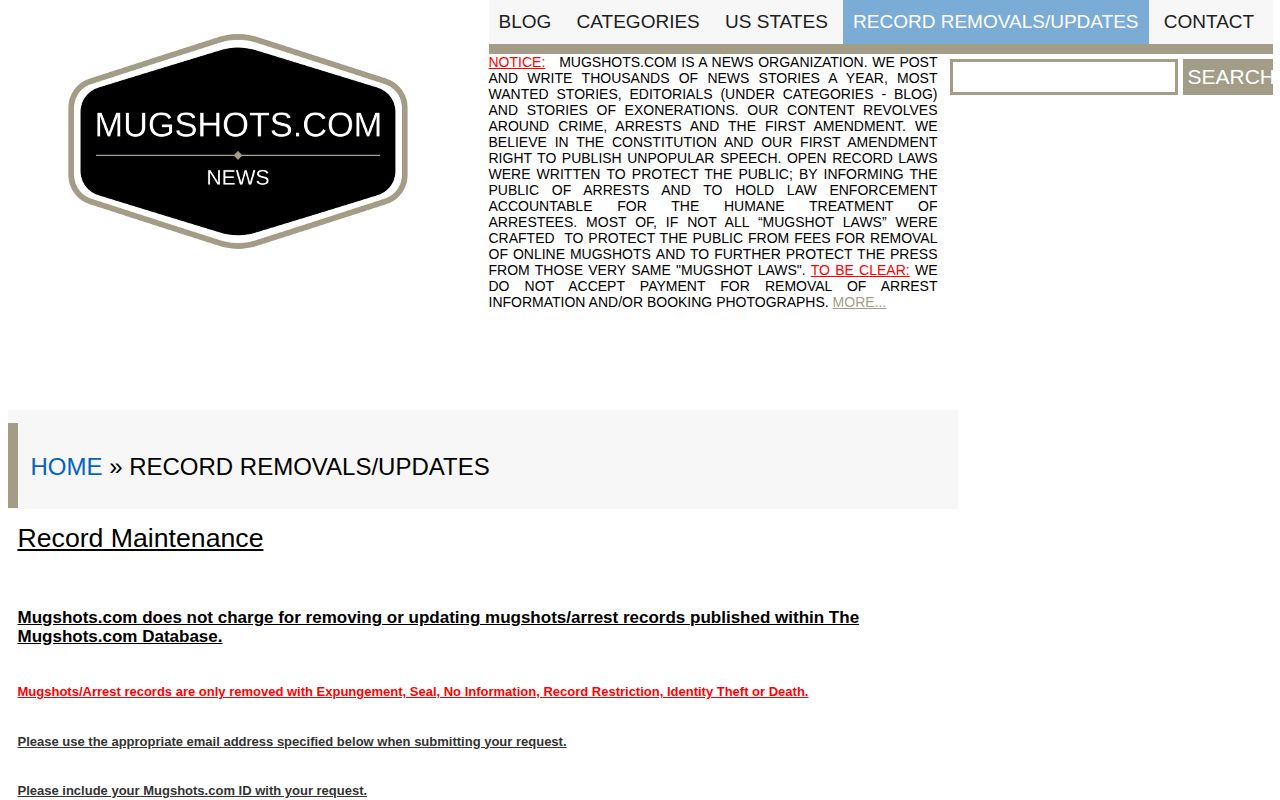
The publisher’s wording splits a record update from outright deletion. That gap matters when a court result changes but an old arrest report still stands.
Mugshots.zone is built on county subdomains, with no stable New York-wide landing page. Its Nassau County request form covers free requests for an error or a qualifying legal outcome. It wants documents plus the exact page URL. The five-to-ten-day estimate belongs to that form alone, not the state. New York Arrests.org shows no clear free removal path. Its contact page is not an opt-out policy, and privacy or advertising settings will not erase a record.
Fix the official record first. Ask the agency or the court. Then use the publisher’s free route and keep a copy of the request. A search engine may refresh its result once the source page changes. But it cannot touch the underlying record.
Note: No publisher policy guarantees removal, and a private copy may survive even after an official record is sealed.
Skip anyone selling universal deletion or charging for a request the publisher calls free. New York has no blanket order forcing every private site to erase a copy.