
New York State Police
New York's statewide patrol and investigative force is the New York State Police. Its newsroom sorts public releases by headquarters, troop, and zone. Posts there cover arrests, open investigations, and missing or wanted people. They also cover traffic safety and enforcement campaigns. So it works as an official source of New York State Police arrest news. It is not a live roster of everyone taken into custody across New York. NYSP also posts activity reports on its own operations. Those answer a different question than a county jail search. They show what the State Police has published. A county roster shows who one jail holds at a given moment. An arrest can end in a local court appearance. It can also mean a release, or transfer to a county facility. The agency's post may not track every later custody change or court result. Think of three records answering three questions. An NYSP release tells you what the agency chose to report. A jail roster shows custody at one facility. A court record shows later case action. None replaces the others. If someone gets released, a current roster may drop the name. The arresting agency's own report is still the record to request. Enforcement releases often use the term DWI, meaning driving while intoxicated. A court can reduce or dismiss a listed charge. Only the court record shows that later outcome. So treat a press release as the agency's account from the day it was issued.
Newsroom and Media Reports
New York State Police arrests surface through several official channels. Each channel has its own job. The newsroom is the best place for named arrest news. The daily Media Reports grid offers a current activity view. Campaign releases sum up a set enforcement period. None of them is one searchable record. It is not a record of every NYSP arrest.
| Official channel | What it publishes | What it does not establish |
|---|---|---|
| NYSP Newsroom | Press releases about arrests, investigations, missing or wanted people, traffic safety, and enforcement campaigns. Troop and region filters and a mailing-list option help readers follow published items. | A complete arrest list, current jail roster, or full case history. |
| Daily Media Reports | Current activity links arranged in a troop and zone grid across weekday columns. | A permanent archive or a guarantee that every incident will appear. |
| DWI and enforcement results | Filtered newsroom items and campaign summaries, including holiday enforcement announcements. | A daily count of all arrests or a person-by-person booking feed. |
| Troop public information contacts | Press contacts organized around NYSP's troop structure. | A records search or a substitute for a formal report request. |
Always read published totals with their stated time frame. One NYSP announcement reported 247 impaired-driving arrests over Thanksgiving. A separate Christmas-New Year's release reported more than 47,000 tickets. Different periods, different measures. Tickets are not arrests. Neither number is a statewide daily arrest total. A release may name a charge, an arrest location, or a court appearance. Detail varies case by case. A name or date missing from a newsroom search does not mean no arrest happened. The newsroom also has a mailing-list option plus filters for troop or region. Those tools help you follow new posts. A mailing list still cannot turn selected news into a full arrest feed, though. A release may summarize an enforcement effort rather than name every person. A daily activity report may link to a short item with little context. Read the source's own description before treating any post as a complete case record.
Find a NYSP Arrest Report
Match your search to your question. The newsroom fits when NYSP chose to announce an arrest. The media grid fits for current activity by troop or zone. For a person-level custody check, go to the facility named in a release or court record. State Police runs no statewide jail roster.
- Search the newsroom. Use the troop or region filters and try the person's name, town, or an incident term. Read the full release for the date, location, and court information it provides.
- Check current activity. Open the Media Reports grid and select the relevant troop, zone, and posted date. The Daily Arrest Report page explains how this current statewide window differs from county booking feeds.
- Follow the named custody location. If an official release or court record identifies a county jail, use that county's official roster or records contact. The County Directory routes to the locality site for the county-level source.
- Request a record when a post is not enough. Ask NYSP for a record it keeps, or ask the local police or sheriff's office for its own arrest or booking record.
A first name alone rarely gets you there. Add a town, an approximate date, or a troop if you know one, then compare your result against the exact agency and court named in the release. A similar name by itself is not enough.
Note: The media grid displays only reports the State Police has posted for its current window, so older or unlisted incidents may require a records request.
County Booking After Arrest
NYSP arrests people and investigates cases. It does not run jails statewide. After an arrest, a person might be processed by a local police agency, appear before a town, village, or city court, be released, or be remanded to a county facility. Remand means a judge orders the person held. The arrest location alone never tells you which facility will hold someone.
Official State Police releases show why the destination matters. In one case from Schroon Lake, NYSP reported arraignment in Elizabethtown Town Court and remand to Essex County Jail pending extradition. An arraignment is a court appearance after arrest. Extradition is a transfer to another place that wants the person. That NYSP release, along with another describing remand to Clinton County Jail, shows case-specific routing. Every NYSP arrest does not end up in the jail of the county where it began.
Where to look next: Use the county jail roster only after a release or court record names that facility. A roster records custody at that location; an NYSP newsroom item records selected agency activity. Booking photos are not guaranteed on either channel.
Counted a county jail first when someone is booked there. The county's own booking entry shows current custody. It may carry a photo if the county publishes one. Quick releases cause a gap. The live roster can drop a booking. The agency record still exists on request. A local police or sheriff record also stays with that local agency. It is not held by NYSP.
State custody is a different trail. For that, the New York inmate lookup is the DOCCS source. Search it with a DIN, NYSID, name, or birth year. Results may list a state facility, a status, or certain release details. It is not a fresh county booking search. The public profile does not promise a booking photo either.
NYSP Report Requests and Fees
New York's Freedom of Information Law governs access. The process sits in Public Officers Law §87, with privacy review required under §89. NYSP's Investigative and Other Records Requests page links to an online GovQA form and explains the mail option. A general NYSP FOIL request form is available too.
- Choose the right custodian. Send NYSP a request for a record it maintains. A town or city police report, county sheriff record, or county-jail booking entry must be requested from that local agency.
- Describe the record clearly. Give the incident date and location, involved agency or troop, and the record sought. A reasonable description helps staff locate the right incident without asking for a broad statewide search.
- Submit online or by mail. Use the linked agency request page and its GovQA form, or mail a written request to the Central Record Bureau at the address below.
1220 Washington Avenue, Building 22
Albany, NY 12226-2252
NYSP lists fees by record type. Payment goes by check or money order to the Superintendent of State Police when a fee applies. Confirm amounts on the agency page before sending money.
| Requested item | Listed fee |
|---|---|
| Incident or investigation report | $15 |
| Accident reconstruction report | $15 |
| Paper copies, each page no larger than 9 by 14 inches | Up to $0.25 |
| Digital media | $3 |
| Certified copy | $15 |
| Photographs | $25 |
NYSP says it tries to answer within five business days. That is not a guaranteed deadline. Statewide searches take longer. So do complex requests, records spread across agencies, privacy review, and redactions. FOIL's acknowledgment and estimated-date rules still apply. Exemptions can also let the agency withhold information. A booking photo is not automatic. Owning an image does not mean NYSP releases it.
FOIL presumes agency records are accessible, yet it allows exemptions for personal privacy, active law enforcement, confidential sources, fair-trial concerns, and investigative methods. New York's booking-photo rule demands a record-specific privacy review. A photo counts as an unwarranted invasion of privacy unless release serves a clear law-enforcement purpose and no other law blocks it. A request may return a report without every image or detail.
Accidents follow a separate NYSP accident-report request path. Collision reports may appear after about 30 days, often within three to six weeks; Thruway or DMV records can sit with a different custodian. An accident report is not an arrest report.
Troop and Zone Activity
The NYSP publication grid is statewide in geography but shallow in history. The troop structure gives the statewide grid a regional map, and the daily view narrows current activity by troop, zone, and date. The official troop-location page identifies the statewide troop areas; the troop public information page lists related press contacts. The newsroom also organizes releases by headquarters, troop, and zone. These tools help route a question to the right area without turning the grid into a statewide name search.
The grid's weekday columns link to daily reports; the visible dates are the working window. NYSP states that daily reports are not archived. Older activity may survive as a separately issued newsroom release, but the grid itself should not be treated as a long-term incident history. The newsroom remains the more useful source for an older case that received a public release.
The Media Reports interface shows how the current grid groups entries. Open the official NYSP Media Reports grid to see its live troop and zone links.
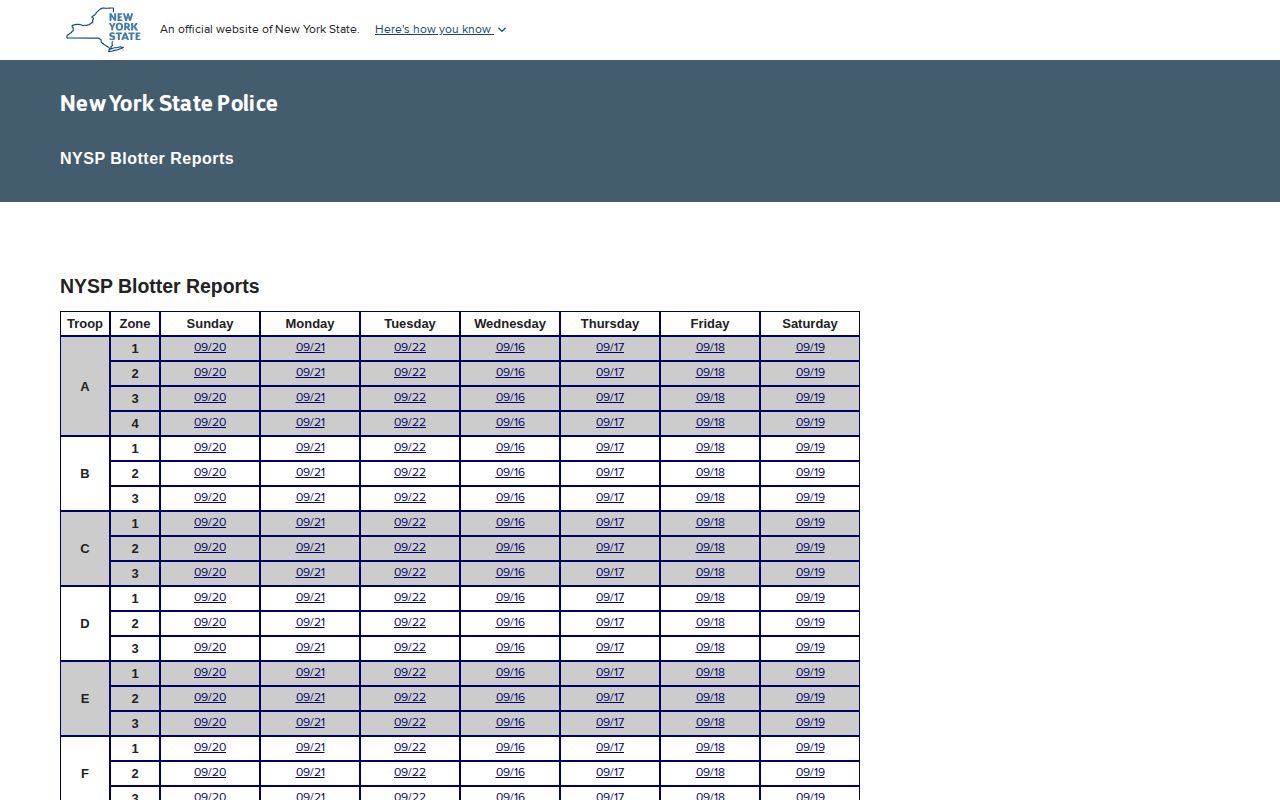
The official Media Reports grid shows date links grouped under weekday columns. It is not a list of every person booked in New York. Daily reports are not archived. Older activity needs a dated newsroom release or a records request. Anything outside the visible window takes that extra step.
Note: A current grid link and a lasting press release have different archive value, even when both describe the same enforcement event.